
I’m a self‑driven, results‑focused professional with a broad skill set and a proven history of delivering meaningful impact. I don’t just provide solutions; I actively pursue them. When I don’t have an answer or direction, I research, test, and uncover it. My priority is helping organizations grow, perform, and succeed through competence, adaptability, and strategic execution.
Engineering, Technical Experience & Services
Phone: 661-365-5792

-
Product R&D and Product Management, Design for Manufacturing (DFM) across Consumer Electronics, Pro/Commercial environments for Audio‑Video, Security, Home Automation, LED Lighting, AC/DC Power, Wired/Wireless Networking, and IP/PoE systems. Experienced in taking hardware and software designs from proof‑of‑concept through full product launch.
-
Value‑Added Product Solutions Engineer with deep expertise in creating innovative, market‑ready solutions.
-
Electronic Engineering, Technical CAD drawings, and Consulting for product development, system architecture, and engineering documentation control/management.
-
Residential and Pro Audio/Commercial AV, Lighting, Security and Automation System Integration, including technical design, system layout, and implementation strategies for new construction projects and retrofits.
-
Creation and design of product catalogs, brochures, technical literature, instruction manuals with detailed product information/ technical specifications, packaging, website technical information/diagrams, and application notes.
-
UI/UX Design for intuitive, user‑focused interfaces across hardware and software platforms.
-
Development of technical training materials and support documentation for sales teams, trade shows, and partner education.
-
Creation of technical concepts, imagery, and presentations for customer engagement, email campaigns, LinkedIn content, training, and marketing initiatives.
-
Marketing support through technical resources, product insights, and strategic guidance to strengthen brand awareness and identify key markets and customer segments.
-
Extensive familiarity with industry leaders in AV and home automation products, systems, and technologies.
Please Note! This website is constantly in flux and a work in progress and is being updated, modified on a reqular basis.
Explore
Product Creation & Development using Electronic Schematic Design & Capture software following
industry Best Practices and Guidelines
-
Schematic accurately represent your design and is easy to read and understand.
-
Ensure proper component symbols and designators are correct with the correct descriptions.
-
Alphanumeric Grid based designs can be created to assist in targeting specific components or circuitry for specific reference in measurement or signal tracing and testing. For service purposes or product adjustments of dip switches setting and trim style potentiometers.
-
Clearly defined Power, Signal Input and Output termination types and connection points like jacks, connectors and wiring.
-
Drawing Revisions and Dates are correct and up to date to insure the most accurate Drawing is inline with all the other supporting CAD, PCB files.
-
Utilize SPICE tools. This will tell you whether or not your circuits will work as designed, predict their behavior while the board is operating, and expose unexpected behaviors in the circuits that may need improvements or changes.
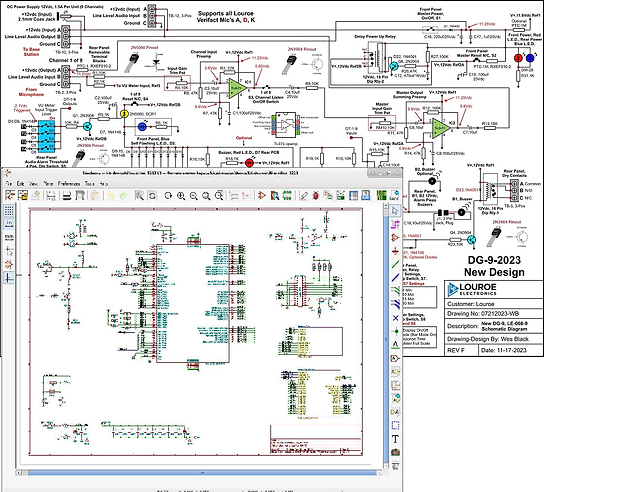


Click Here to open the PDF document.

Click Here to open the PDF document.

Oscilloscope

Signal Generator

Digital DC Power Supply
Electronic test and measurement is a vital discipline within engineering and technology, dedicated to assessing the performance of electronic components, circuits, and systems. It ensures that electronic devices function properly and comply with defined standards. Precise measurements play a key role in quality assurance, troubleshooting, and advancing research and development across industries such as electronics, telecommunications, and automotive engineering. Key test and industry measurement standards (like ISO 9001, IEC 61010, or IEEE calibration standards) are essential and ensures instruments are designed to protect users from electric shock, fire, and mechanical hazards, provides compliance with safety standards and is often a legal requirement for selling equipment worldwide. Together, they protect people, guarantee product quality, enables global trade, and fuels innovation.
Why Test Equipment Matters in Standards
-
Verification of compliance: Standards (like IEC, IEEE, ISO) require precise measurement of voltage, current, resistance, frequency, and signal quality. Test equipment ensures devices meet these benchmarks.
-
ISO 9001 → Ensures quality management and reliable calibration processes.
-
IEC 61010 → Protects users and equipment through strict safety requirements.
-
IEEE calibration standards → Provide technical rigor and traceability for precise measurements.
-
Quality assurance: Accurate testing prevents faulty products from reaching the market.
-
Safety: Standards often define safe operating ranges; test equipment validates that devices won’t pose hazards.
-
R&D and innovation: Engineers rely on measurements to refine designs and push performance boundaries.
Role of Analog Test Equipment
-
Continuous representation: Analog meters (like needle-based multimeters, oscilloscopes, or gauges) provide a smooth, real-time view of signals.
-
Intuitive feedback: Engineers can quickly see fluctuations, trends, or noise in a signal.
-
Useful for dynamic signals: Analog displays can reveal transient behaviors that digital sampling might miss.
-
Standards relevance: In calibration labs and legacy systems, analog instruments are still used to cross-check digital results and ensure traceability to older standards.
Role of Digital Test Equipment
-
High precision & accuracy: Digital multimeters, spectrum analyzers, and logic analyzers provide exact numerical values, often with auto-ranging and error correction.
-
Data storage & processing: Digital instruments can log results, apply statistical analysis, and integrate with software for compliance reporting.
-
Standardization: Digital equipment aligns well with modern test standards that require repeatability, traceability, and automated documentation.
-
Advanced features: Filtering, averaging, and digital signal processing (DSP) allow compliance with tighter tolerances in standards like 5G telecom or automotive electronics.